Tuning Forks and Pitch
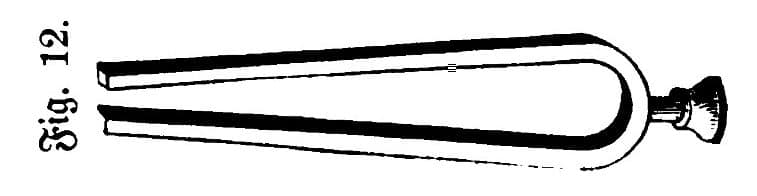
Early French style tuning fork with stand, usually in brass, in part, to avoid marring a soundboard. From Kunst des Klavierstimmens, p. 68, by Giorgio Armellino, publ.1881.
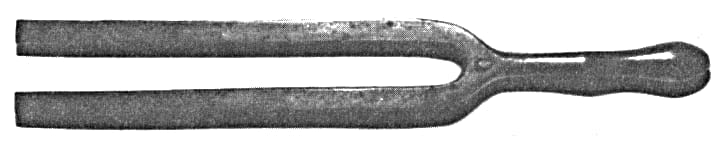
Original tuning fork made by John Shore (1662-1752), inventor of the tuning fork which he gifted to George Frederick Handel (1685-1759) with a pitch of C 512 (A 422.5). Photo from The Royal Society of Medicine.
Interestingly, John Shore’s original tuning fork appeared remarkably similar to the modern tuning forks produced in the 20th century, with a simple and straightforward design profile.
John Shore was an English Royal Court trumpeter and lutenist, who invented the tuning fork in 1711. Shore performed many demanding trumpet parts in Handel’s compositions, and Shore and Handel became close personal friends. Later in life, after injuring his lip playing trumpet, Shore switched to playing the lute. It was through the challenges of tuning lute strings that Shore developed the tuning fork; before that, most musicians who needed a pitch reference, relied on wooden pitch pipes, if not calculating pitch from local bells or nearby church organs. Wooden pitch pipes were unreliable, being greatly affected by changes in humidity and temperature. The tuning fork was a major improvement over wooden pitch pipes in that they maintained pitch well under a wide variety of temperature and humidity conditions, as well as producing a clear and pure tone. The A 423 pitch was adopted by a number of Baroque and Classical era ensembles between circa 1750 and 1820.
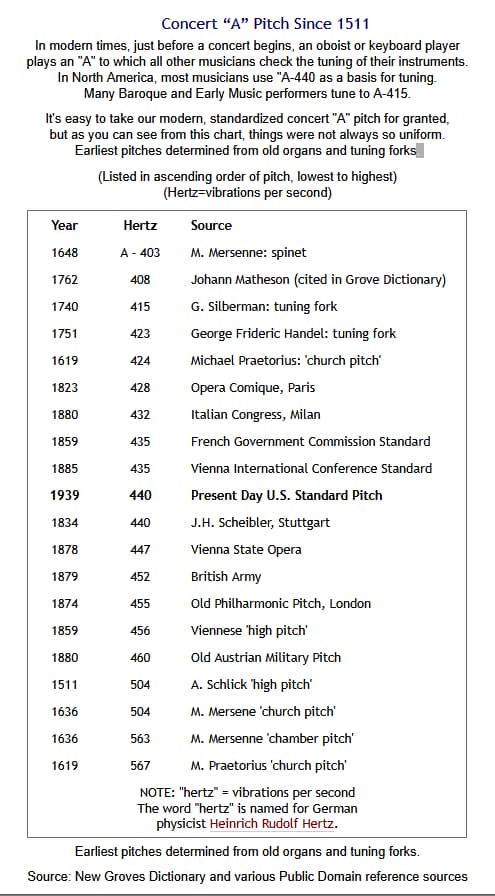
Throughout recorded history, and to the present day, there has been no universally predominant standard musical pitch. Since 1939, there has been a concerted effort to establish A440 as the universal standard pitch, and A440 has gained considerable acceptance over the years, but even so, pitch has ranged from A415 for some early music ensembles, to A444 for some orchestras. The diversity of musical pitch was perhaps even greater in the nineteenth century, however, and varied between A423 and 457.
Concert “A” Pitch Since 1511 by David Gordon Pacific Grove, CA. www.spiritsound.com

In the 1885 Hammacher Schlemmer catalog, both A and C forks are offered for sale, but curiously, no pitches are given for either.
The comprehensive 357-page American Felt Company catalog for 1911 has a number of forks available both in traditional polished steel as well as the new “blued” forks (to prevent rust) between a low pitch of A435 and a high pitch of A454. It was common to tune very high A between the 1860s until the turn of the twentieth century, in the U.S. as well as much of Europe. Here are two pages from that catalog:
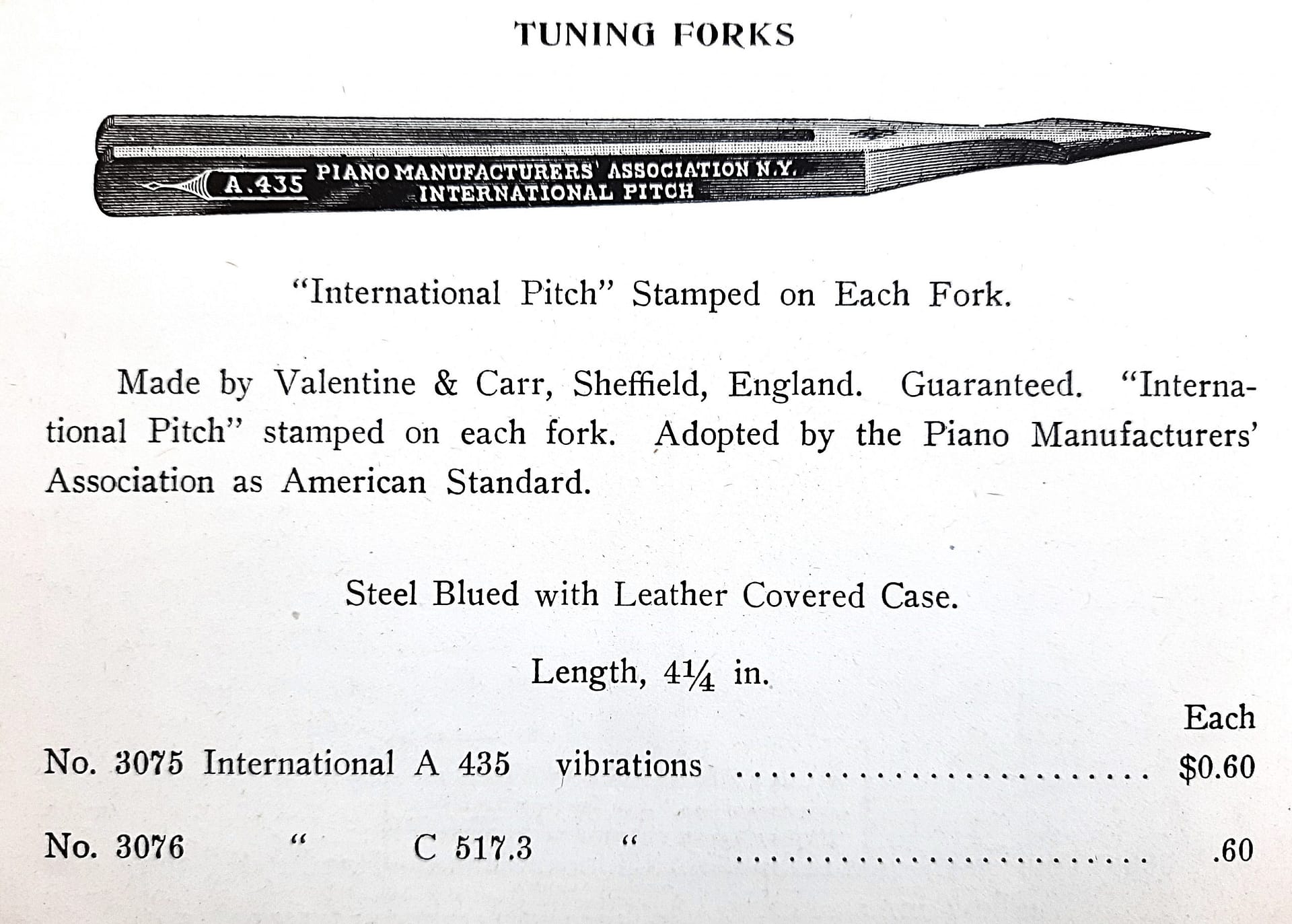
American Felt Company catalog for 1911.
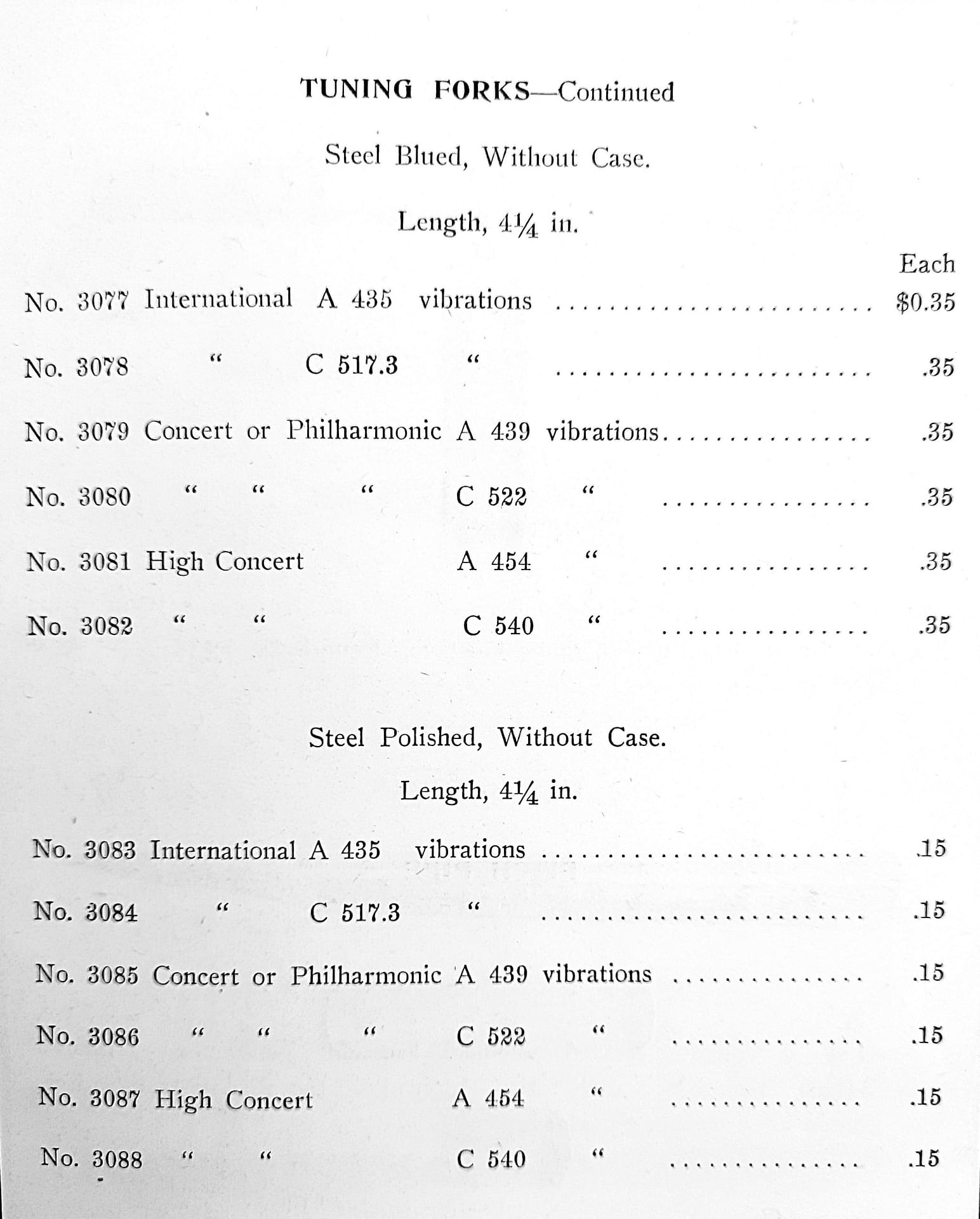
American Felt Company catalog for 1911, cont.
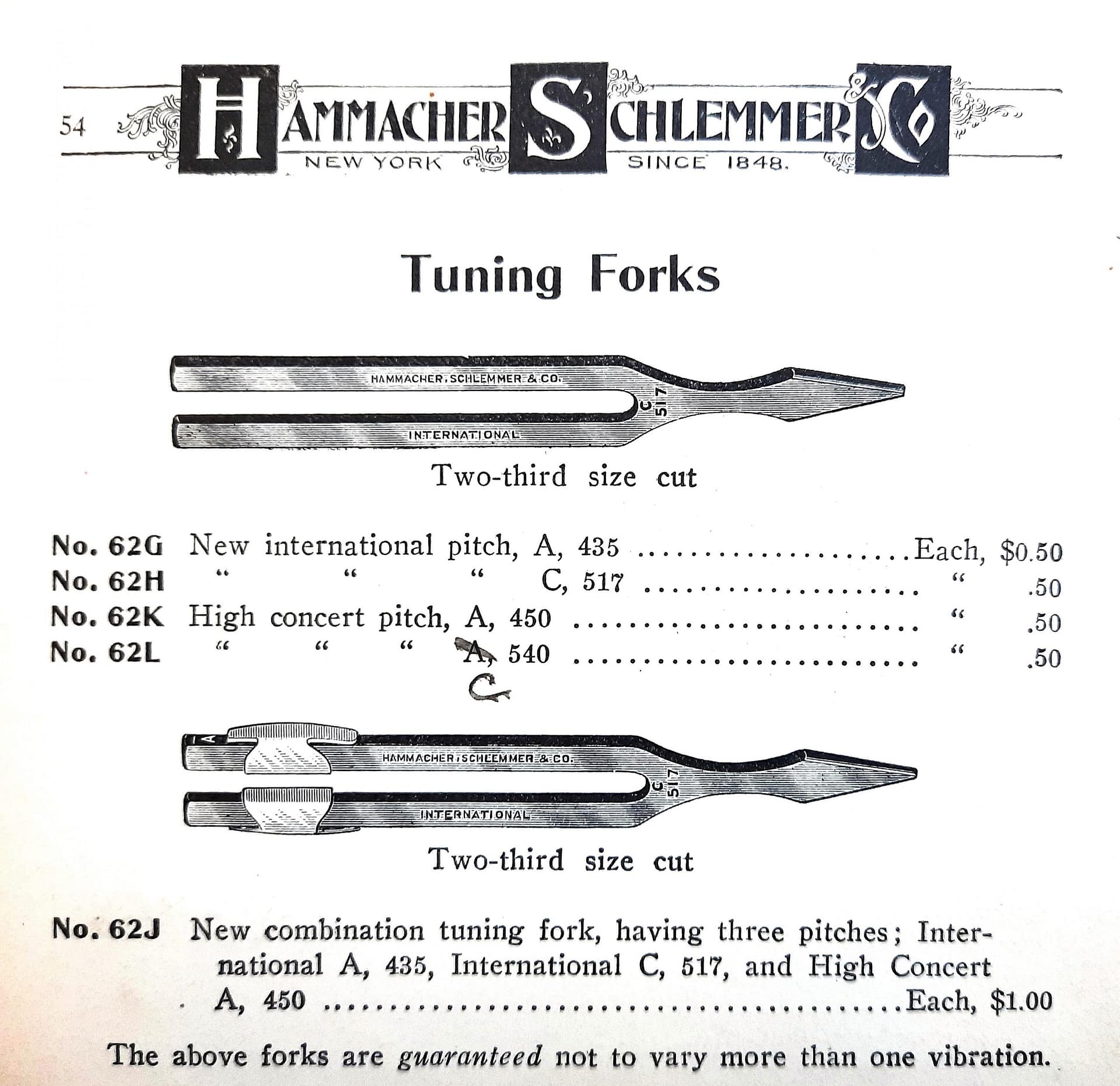
Even in 1918, H. S. and Co. did not include an A440 fork! Surprisingly, an A450 fork was still being sold. These high pitched forks are quite uncommon today; they must have been thrown away en masse.
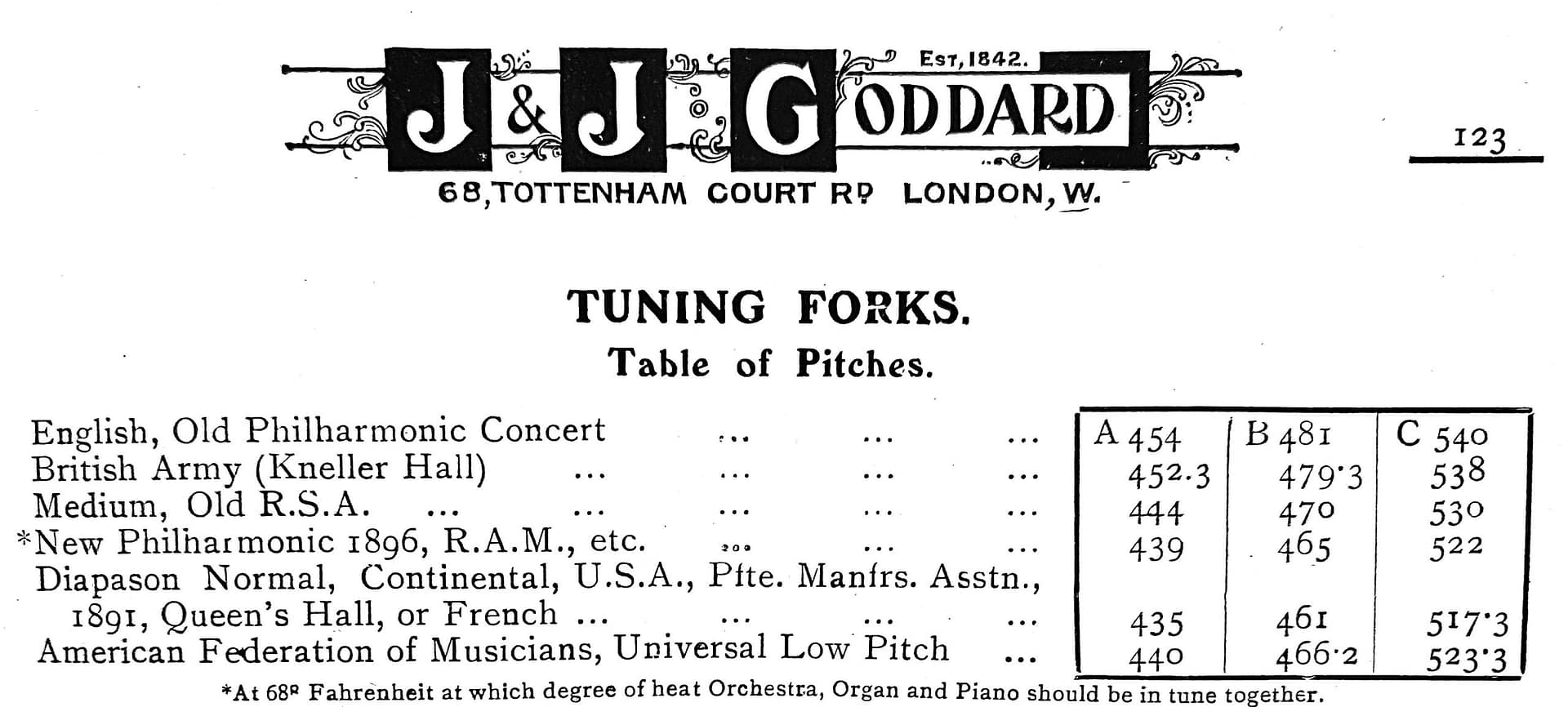
Table of Pitches from J.& J. Goddard 1920 catalogue.

Inscription on A440 tuning fork. “Universal Low Pitch”: A440.
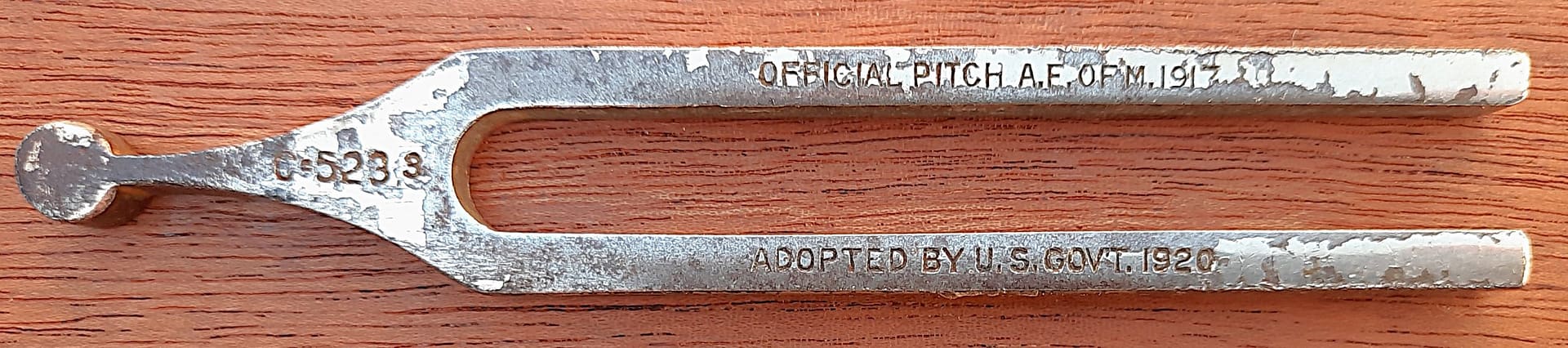
Deagan C 523.3 (A440) tuning fork, circa 1920, “Official Pitch.”
Authors of this French decree of 1859, endeavored to establish a uniform pitch in France of A435, later known as “International pitch.” The French physicist Jules Antoine Lissajous had observed in 1855 that, “…the pitch varies not only from town to town and country, but it changes in one country and in one theatre from year to year.”
The French commission included the following people: J. Pelletier, President, F. Halevy, reporter, Daniel Auber, Hector Berlioz, Despretz, Camille Doucet, Lissajous, General Mellinet, Giacomo Meyerbeer, Ed. Monnais, Gioachino Rossini, and Ambrose Thomas.
“On the 1st February 1859, the Commission handed its report to the Minister of State. This report was followed by a decree dated the 16th of February 1859, fixing for France an official pitch having 870 simple vibrations per second at 15 degrees C., and known by the name of diapason normal or normal (standard) pitch.”
–“A Practical Manual for the Piano and Harmonium Tuner,” by E. Nugues, H. C. Pouget, and Ch. Martin, published by Leon Pinet and Co.
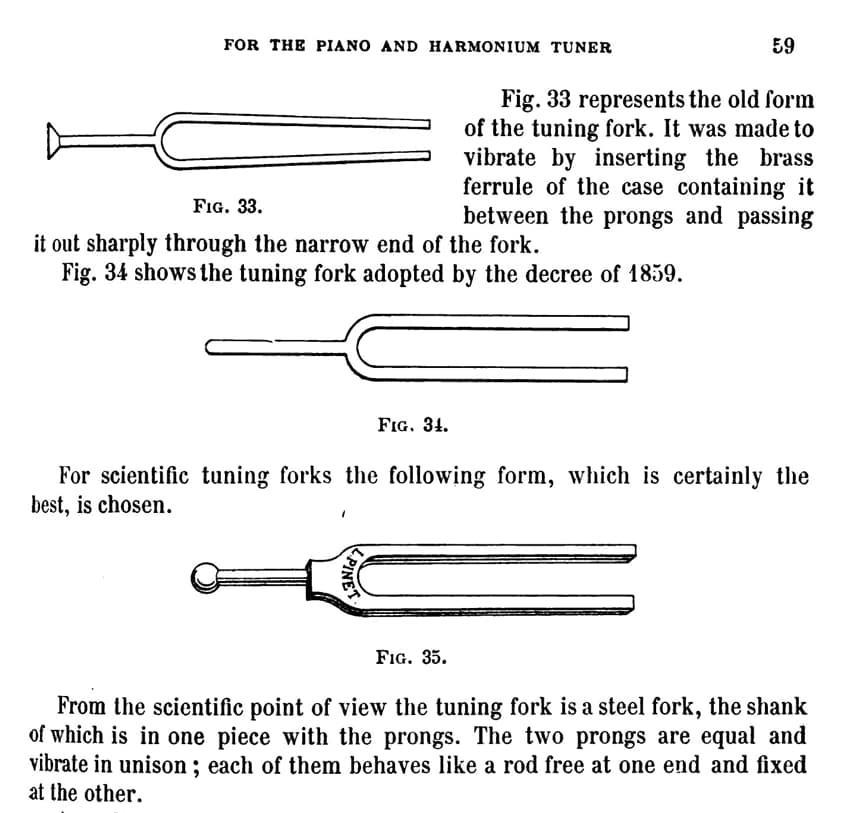
Antique tuning fork, French Pattern Tuning Fork circa 1859, an “Scientific” modern tuning fork. From Practical Manual for Piano and Harmonium Tuner, by Nugues, Pouget, and Martin; published by L. Pinet 1913.
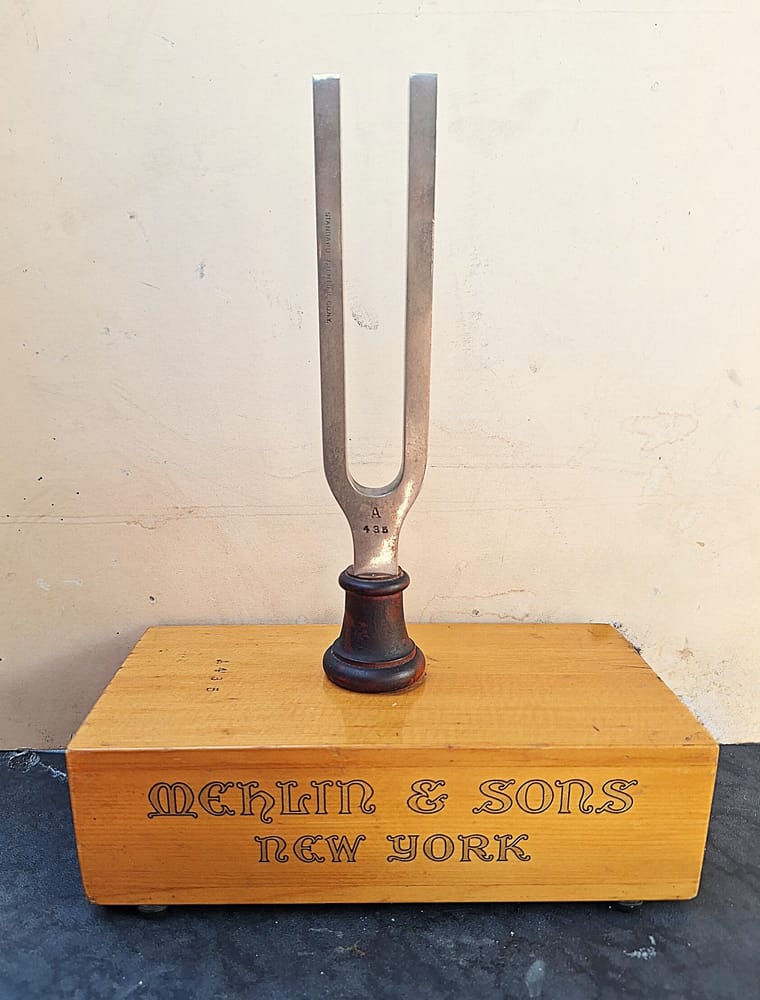
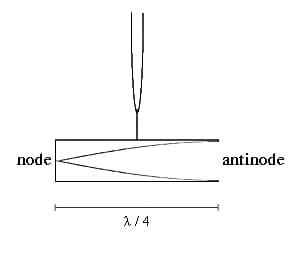
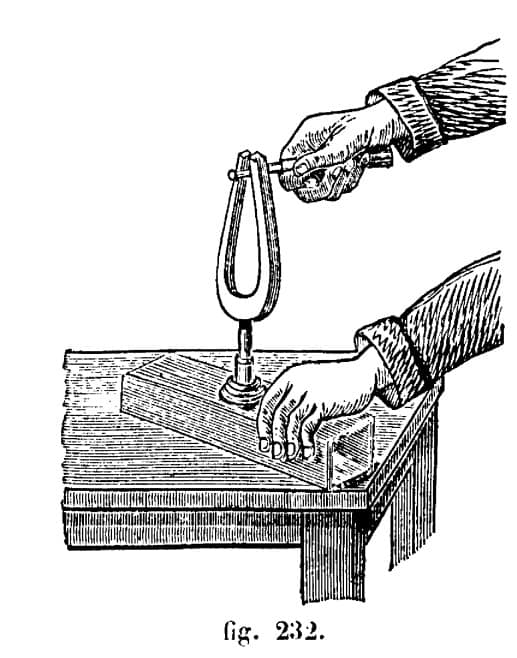
A large tuning fork with spruce resonator box with a pitch of A 435. Mehlin & Sons Piano Co. probably used their own soundboard stock to make the resonator box, which amplifies the sound of the fork as well as prolongs the length of sustain. The resonator box was invented by Albert Marloye (1785-1874), a French instrument maker in 1839. The size of the box is one fourth the length of the sound wave in air, and forms a node point at the closed end of the box, and an anti-node point at the open end of the box. Drawing, Case Western Reserve University.
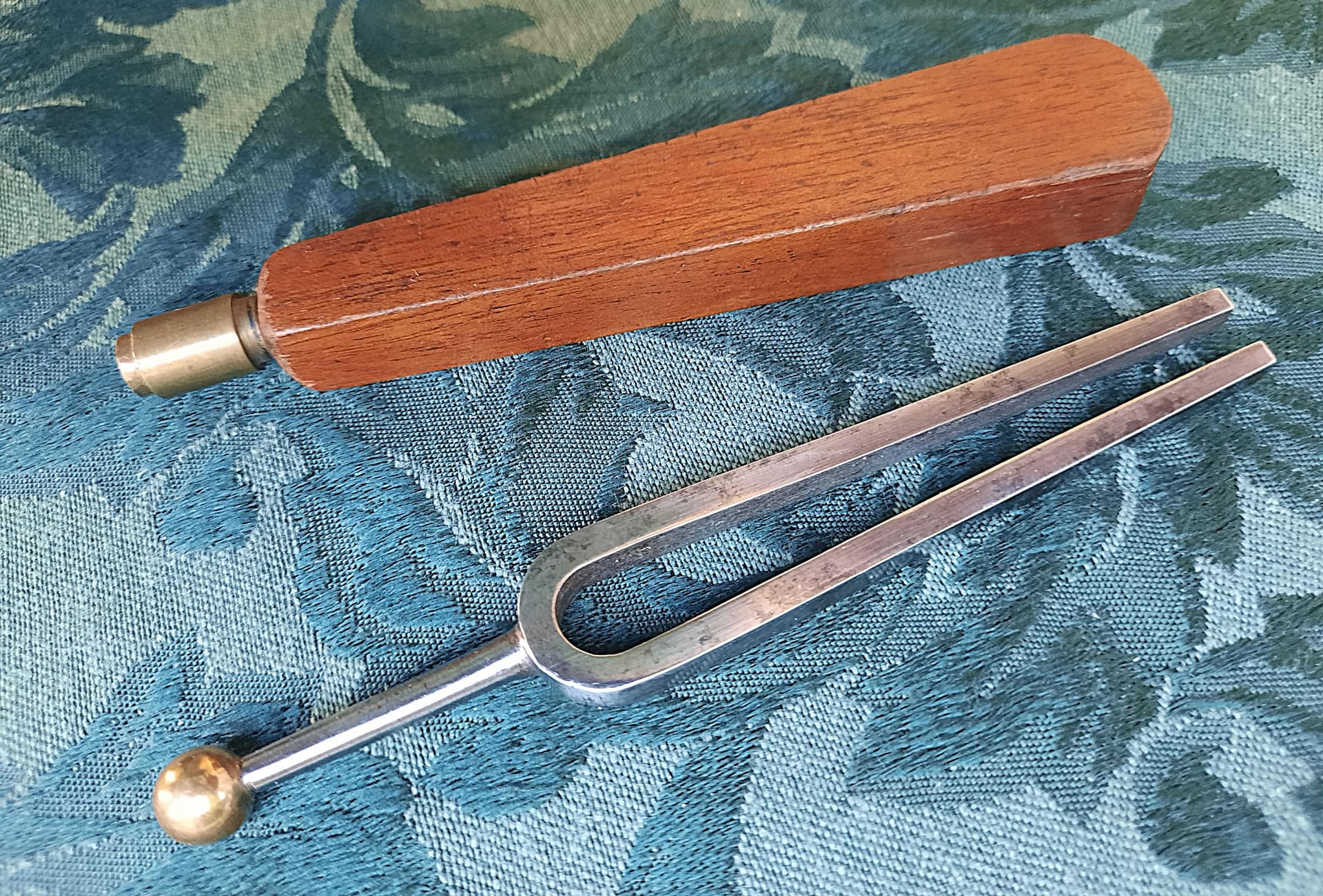
Old French fork which is sounded by pulling the brass ferrule of the case through the small opening between the tines of the fork.
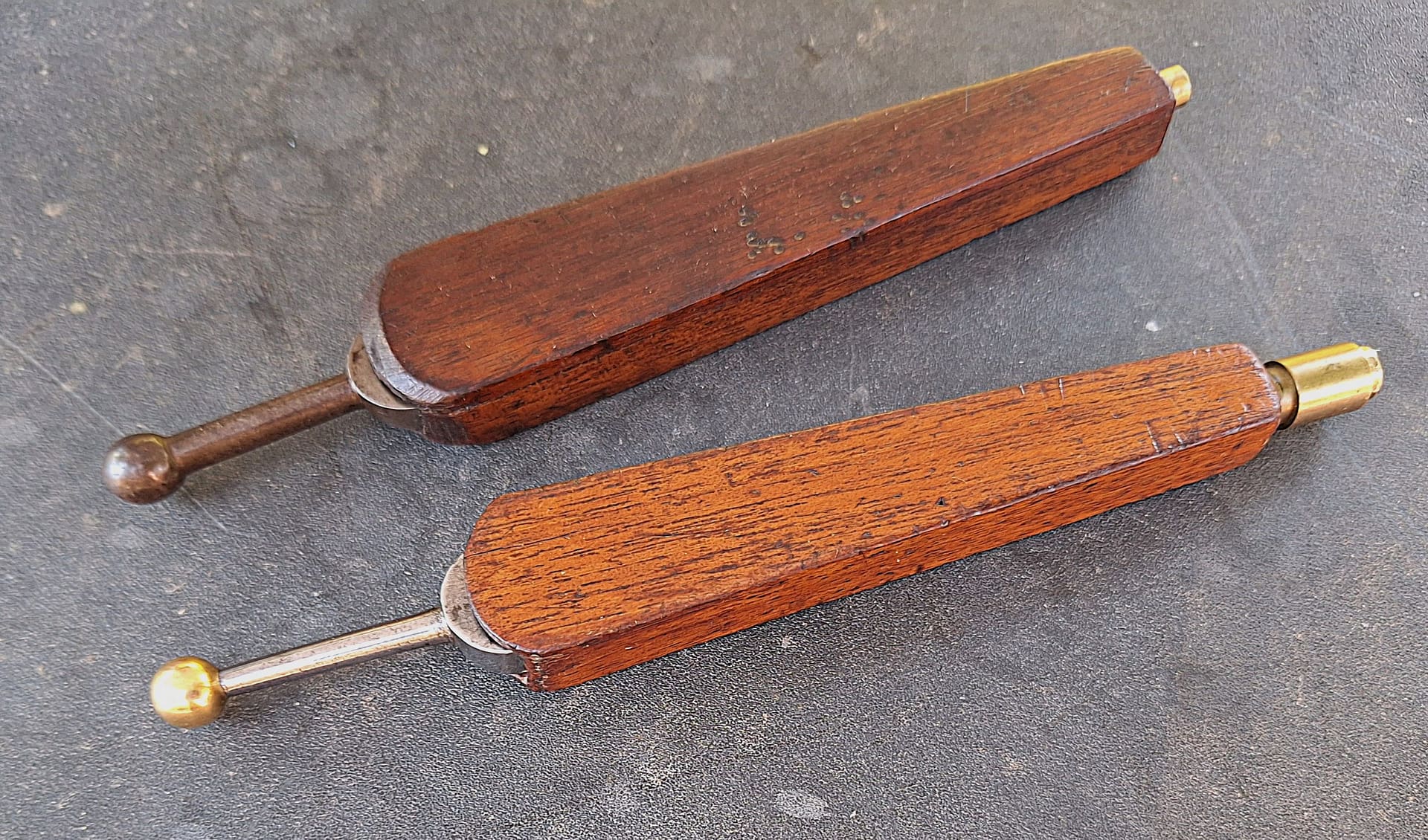
Two 19th century French tuning forks in their mahogany cases, with brass ‘ringers’ at the tip. Front A440; back A430.
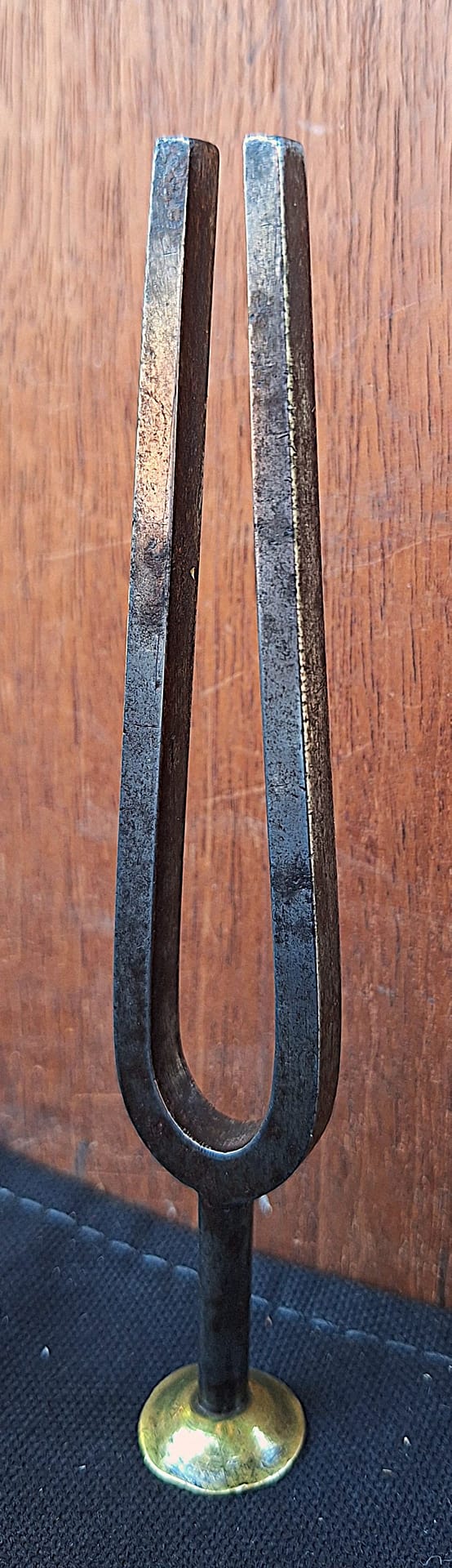
Early 19th century French Tuning Fork (l.) with a brass pedestal has a low pitch of A421.
Diapason mounted on resonator box (r.). Illustration from Il Pianoforte; Guida Pratica by Giacomo Ferdinando Seivers, published 1868 by Ghio, Napoli.
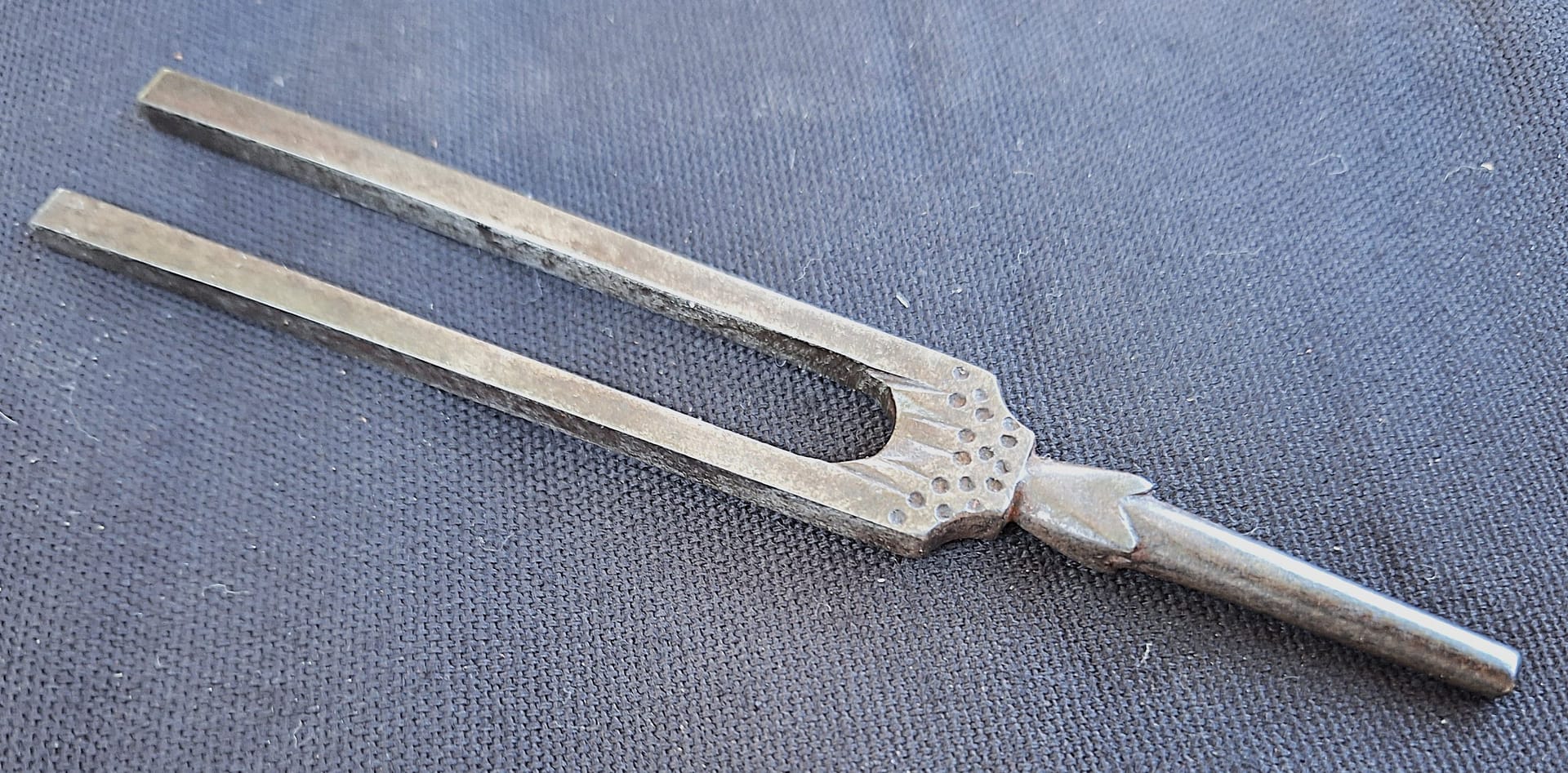
Early A422 Tuning Fork with ornate handle.
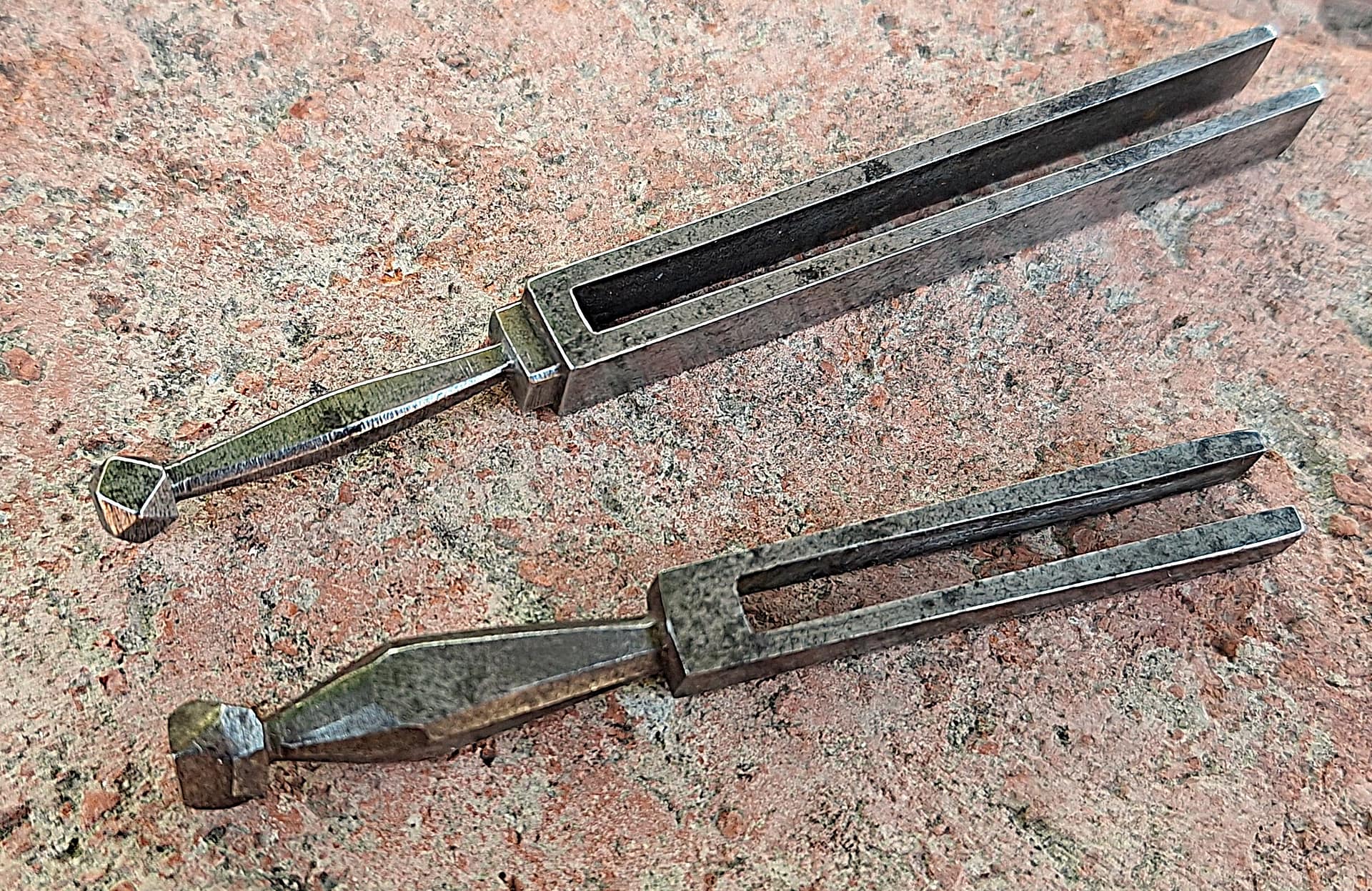
Two early Tuning Forks with similar features: small, with squared-off tines, chamfered handles, and polyhedral tips. Foreground, equivalent of A430; background, A422.

Ornate early tuning fork with small pedestal, and tin case. This fork was made in the French style, and has metalwork that appears to be 18th century; however, the fork sounds a very high pitch of A450.


Where have all the high pitched tuning forks gone?
Mysteriously, there are very few tuning forks with pitches above A440 that have survived; they must have been thrown away en masse in the 1920s and ’30s. While rare, low pitch tuning forks do turn up occasionally.
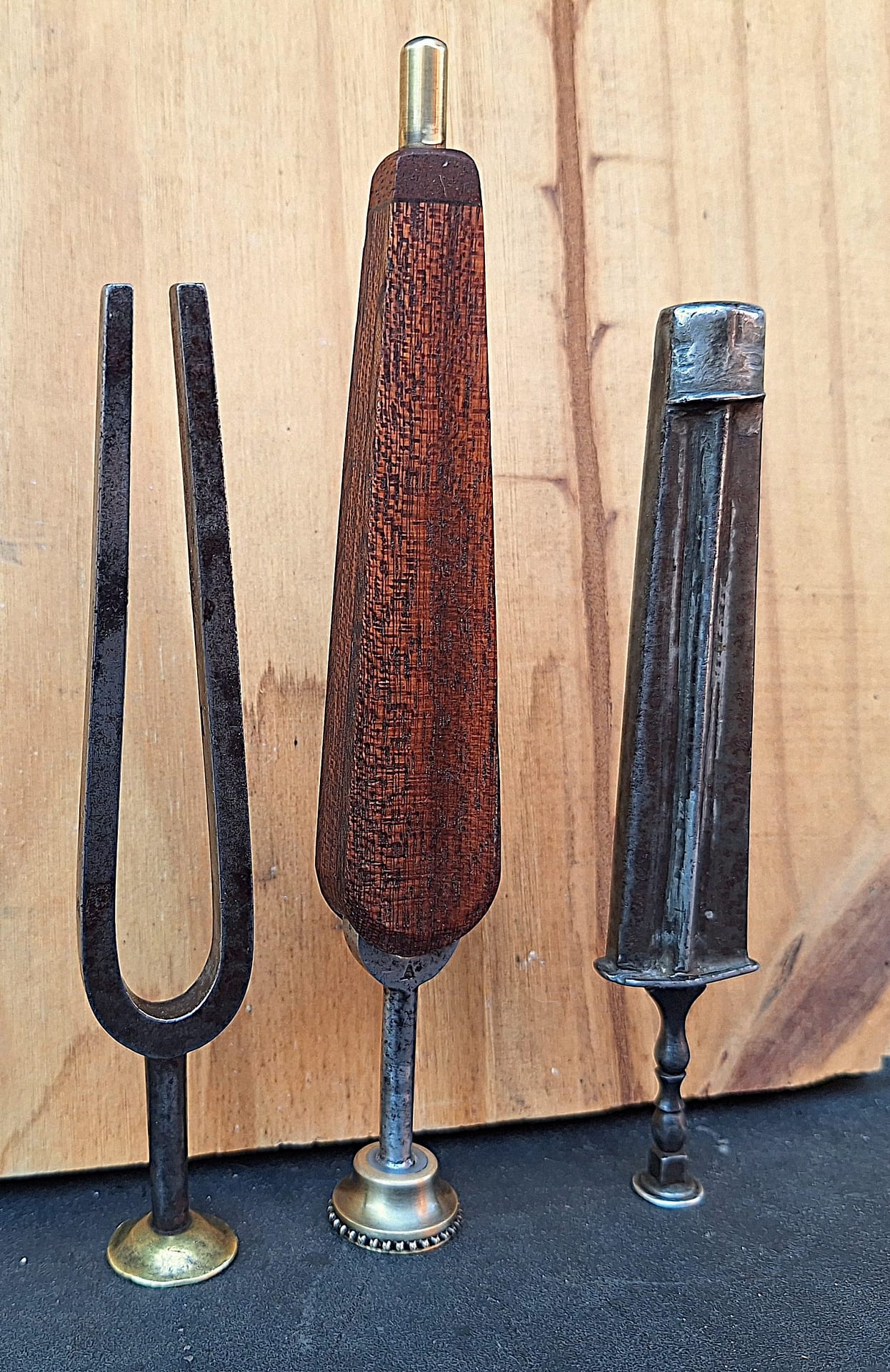
Three antique pedestal tuning forks, l. to r.: A421, A 430, A 450.
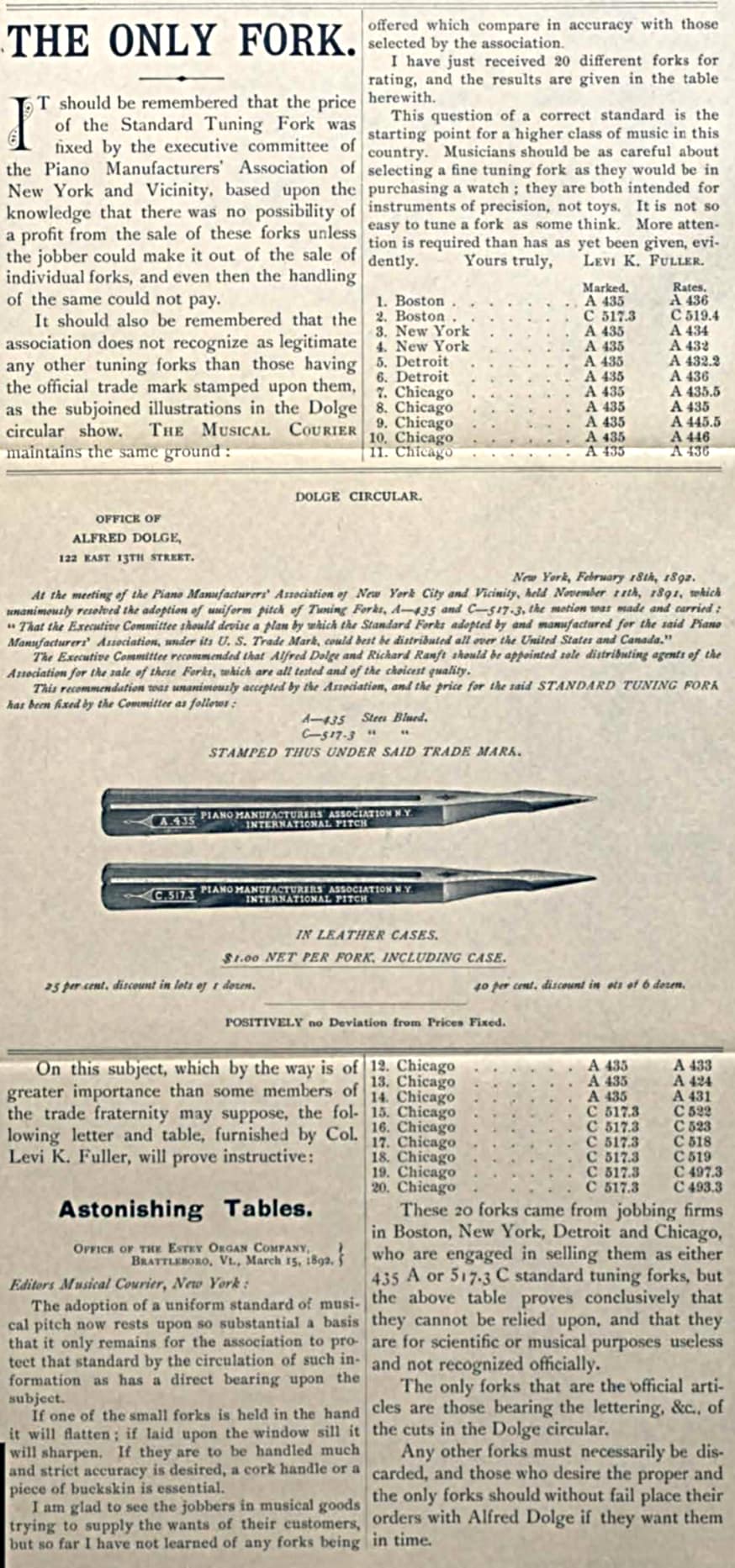
Discrepancies between 20 various tuning forks that were tested. From The Musical Courier, New York, 13 March, 1892. Also Dolge 1892 catalogue.
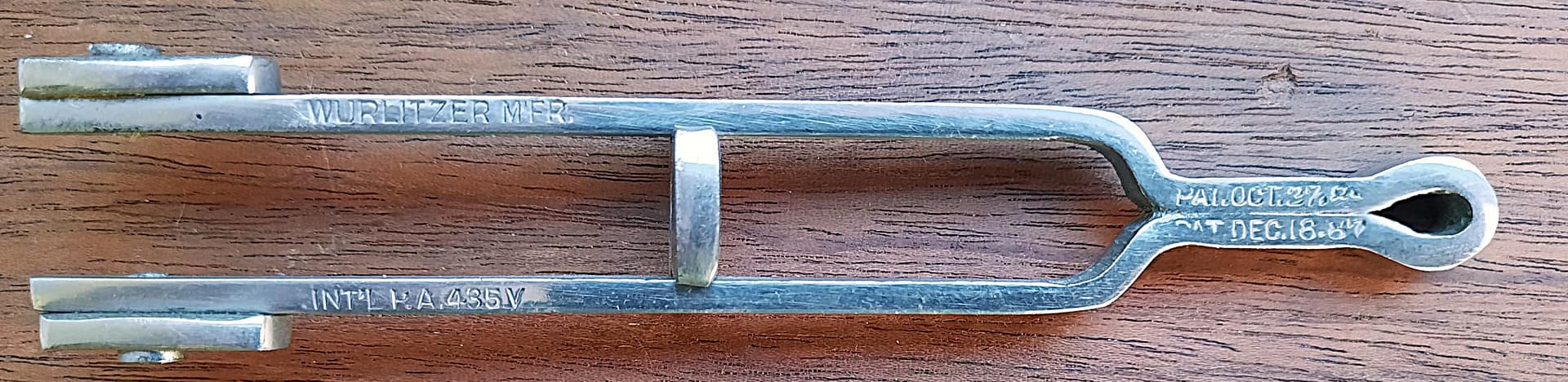
Segrove tuning fork, patented by Segrove in 1885 and 1887, and made by Wurlitzer. The sliding weight selects the note being tuned; the screw-in weights at the top of the tines adjust the overall pitch.
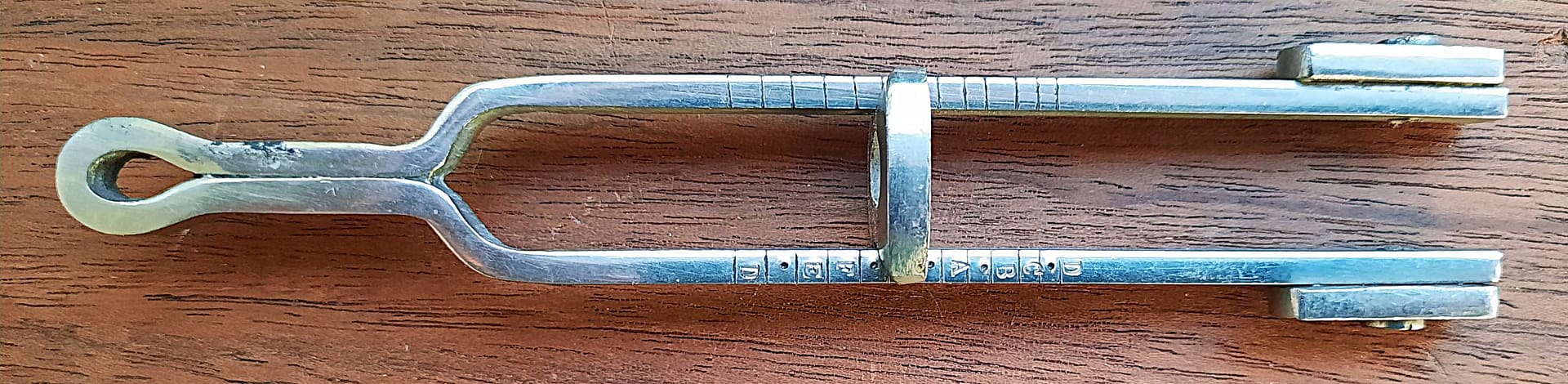
Segrove tuning fork, patented by Segrove in 1885 and 1887, and made by Wurlitzer. Opposite side.
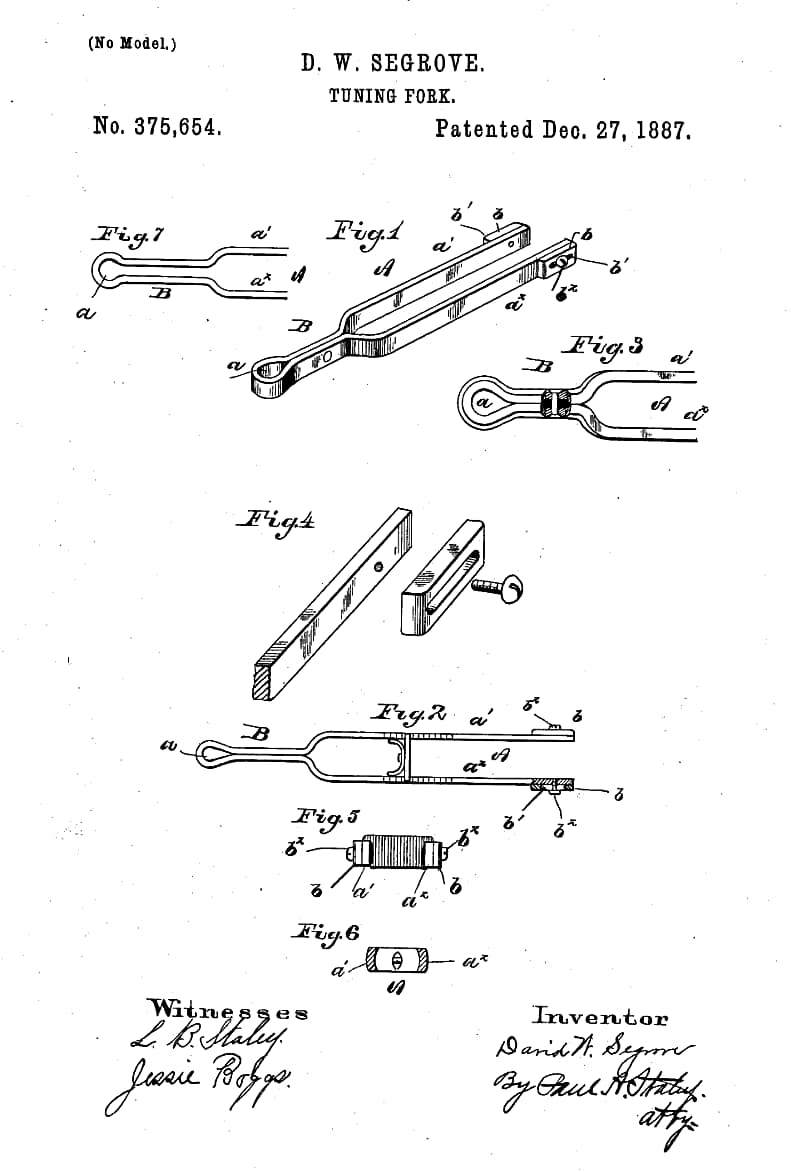
Segrove’s 1887 patent for an adjustable tuning fork.
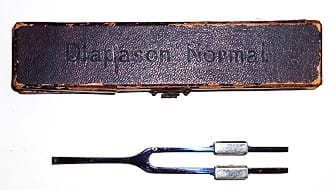
Another adjustable tuning fork, early 20th century. The higher the bridge (away from the crotch of the fork), the lower the pitch, and the lower the bridge, the higher the pitch.
The example above has individual adjustable weights, which, when moved to their seven adjustment points, approximate seven (c to f#) semi-tones of the equally tempered scale.
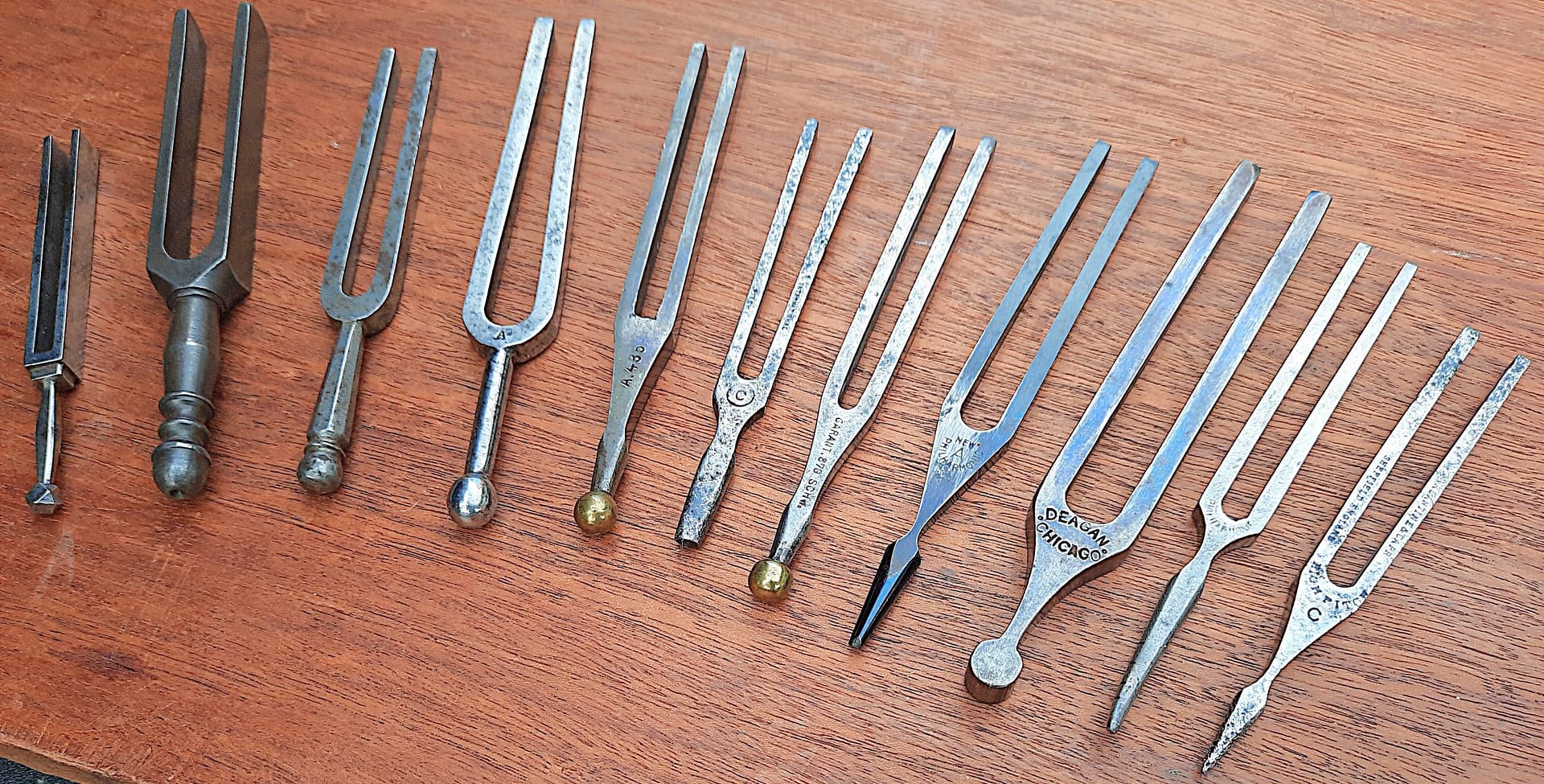
Here are a range of old tuning forks of various forms, ranging in pitch from A422 to A454!
Dr. Edward Swenson has written an excellent article which includes a comprehensive list of many pitches produced by various tuning forks, starting from the time of the invention of the tuning fork by John Shore in 1711.
A435 on spruce resonator box, and A450 inserted.